Former Ohio State Buckeyes football WR reignites feud with Buckeyes in yet another explosive twist
 sammy
sammy 
The pipeline of elite wide receivers flowing out of the Ohio State Buckeyes football has become one of college football’s most reliable production lines—year after year, another polished playmaker steps into the spotlight and onto the NFL’s biggest stage.
From first-round consistency to headline-grabbing prospects, the program’s reputation continues to compound. Names like Jeremiah Smith are already being penciled into future draft conversations, reinforcing a legacy that shows no signs of slowing.
Yet, not every talented receiver to pass through Columbus remains part of that narrative—or wants to be.
Few figures have drifted further from Buckeye goodwill than Jameson Williams. Once a promising piece within Ohio State’s stacked receiver room, Williams chose a different path, transferring to the Alabama Crimson Tide football. His move paid off on the field, launching him into national prominence and eventually into the NFL with the Detroit Lions. Off the field, however, his relationship with his former program—and its fanbase—has steadily deteriorated.
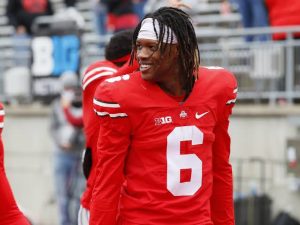
Williams has rarely shied away from voicing criticism toward Ohio State, a stance that has kept tensions simmering long after his departure. For many Buckeye supporters, his continued commentary has turned admiration into frustration, making him something of a recurring antagonist in their orbit.
Now, he’s back in the spotlight for an entirely different reason—one that stretches beyond rivalry and into the evolving business of college athletics.
According to reports, Williams has filed legal action against both the Big Ten Conference and the Southeastern Conference, alleging they profited from his name, image, and likeness (NIL) without proper compensation. His claim arrives at a time when many similar disputes have already been settled or addressed through sweeping changes in NIL policy, raising questions about both timing and intent.
To critics, the lawsuit feels like another chapter in a pattern—one where controversy seems to follow Williams as closely as his undeniable talent. To others, it’s a reflection of the still-shifting landscape of college sports, where past athletes are beginning to revisit what they believe they’re owed in a rapidly monetizing system.
Lost in the noise is a simple truth: Williams remains an exceptional football talent. Despite earlier setbacks, including a suspension tied to league policy violations, he has carved out a vital role in Detroit’s offense. Back-to-back 1,000-yard receiving seasons underline his impact and justify the Lions’ continued investment in his potential.
What happens next, though, is uncertain. Legal proceedings of this scale rarely move quickly, and there’s little indication the case will be resolved before the next NFL season kicks off—if it even advances that far.
For Ohio State fans, the situation only reinforces a complicated legacy. Williams may have once been part of their storied receiver lineage, but his post-Columbus journey has rewritten how he’s remembered—less as a former Buckeye star, and more as a figure who never quite let the past go quietly.