The Good, The Bad, and the Costly: The Canucks’ Most Scrutinized Transactions Under Patrik Allvin
 sammy
sammy 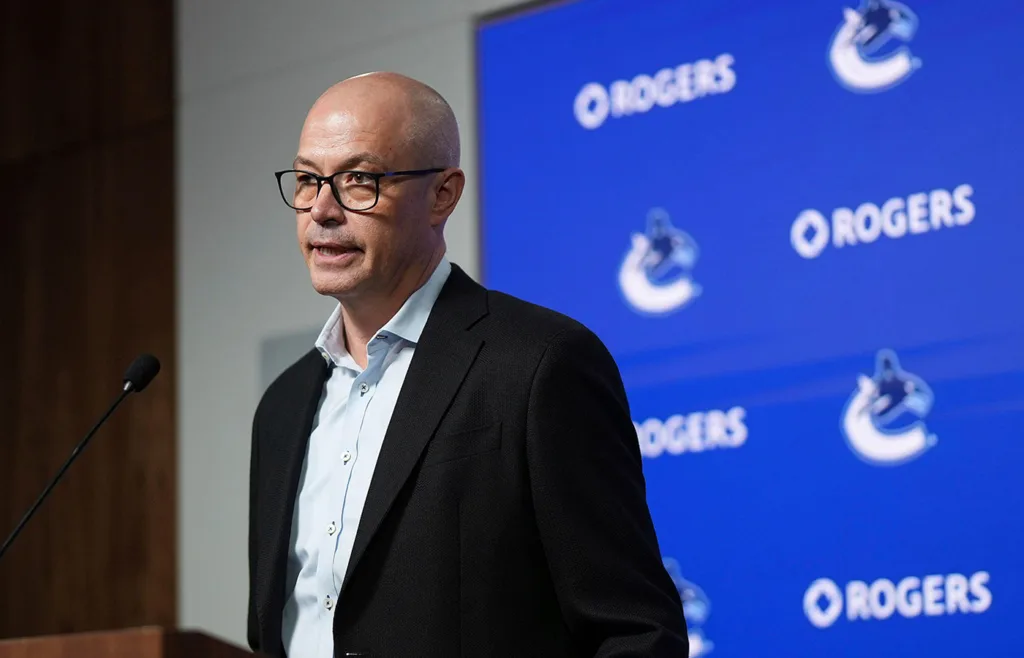
Over the past week, with Patrik Allvin no longer steering the Vancouver Canucks as general manager, reflection has replaced momentum in Vancouver’s hockey conversation. What once felt like a fresh reset under a new regime has now become a mixed ledger of bold swings, uneven returns, and a few decisions that continue to echo louder with time.
When Allvin was first appointed by Jim Rutherford, optimism surged through the organization. The Canucks were trying to escape the lingering shadows of the Jim Benning era, a period widely criticized for short-term thinking and costly missteps. Fans were ready to believe again, and early signs of competitiveness in the 2023–24 push only strengthened that belief.
But as quickly as praise arrived, scrutiny followed. With the benefit of hindsight, several roster moves now stand out as defining pressure points in Allvin’s tenure—decisions that shaped both the roster’s identity and its long-term flexibility.
A mixed legacy in motion
The Mikheyev gamble that didn’t age well
One of the earliest major investments under Allvin was the signing of Ilya Mikheyev to a four-year deal worth $4.75 million annually. At the time, it was viewed as a speed-driven addition meant to add penalty-killing strength and transitional pace.
The reality proved more complicated.
Mikheyev’s first season was heavily impacted by injury, including a torn ACL, yet he still managed 28 points in 46 games. However, his production never fully rebounded, and even in a healthier follow-up season, he plateaued at 31 points across 78 appearances.
His trademark speed also appeared diminished compared to pre-Vancouver metrics, and while deployment issues—such as top-line usage with Elias Pettersson due to lineup constraints—may have played a role, the fit never fully clicked.
The eventual cost of exiting the deal was steep. To move off the remaining contract years, the Canucks not only retained salary but attached additional assets, ultimately sending Mikheyev, Sam Lafferty, and a second-round pick just to secure a modest fourth-round return. From an asset management standpoint, it remains one of the most questioned decisions of the era.
The Horvat trade: a franchise turning point
Few moves defined Allvin’s tenure more than the January 2023 decision to trade Bo Horvat, then captain of the team, to the New York Islanders.
In return came Anthony Beauvillier, Aatu Räty, and a first-round pick later used in another transaction. At the time, the move was framed as a multi-piece retool, even suggesting three “first-round-caliber assets” were coming back.
In practice, the return never matched the symbolism of the outgoing player.
Beauvillier’s short stay ended quickly, Räty struggled for consistent impact, and the draft capital only partially compensated through subsequent moves. Meanwhile, Horvat’s departure left a leadership void and coincided with a visible fracture in locker-room cohesion, especially given the organizational decision to lean into the J.T. Miller timeline instead.
Looking back, the question remains unavoidable: whether retaining Horvat might have stabilized both performance and internal structure during a pivotal transition period.
Podkolzin, Kane, and the cycle that didn’t land
Another storyline of volatility came through the handling of Vasily Podkolzin.
After an extended NHL look and subsequent reassignment for development, Podkolzin was eventually moved out, later becoming part of a chain reaction that saw his draft asset flipped for Evander Kane. The result was a rare full-circle sequence that invited heavy criticism in hindsight.
Podkolzin found renewed success elsewhere, producing career-best numbers and emerging as a productive playoff contributor. Kane, meanwhile, delivered a more modest offensive season and struggled to consistently influence games in the way Vancouver had hoped.
The contrast between outgoing and incoming trajectories only sharpened scrutiny of the decision-making sequence.
A costly deadline in 2025
The 2025 trade deadline added another complex chapter, headlined by the acquisition of Drew O’Connor and Marcus Pettersson from Pittsburgh.
While O’Connor’s extension and production offered some validation, the broader cost of the deal—multiple assets including a first-round pick—has aged poorly, especially given Pettersson’s long-term contract structure and full no-movement protection in the early years.
The timing also raised questions. The Canucks had only recently entered a recalibrated direction, yet quickly committed premium draft capital for players whose long-term fit remains uncertain.
The extension strategy: stability or entrenchment?
The 2025 offseason continued the theme of prioritizing retention over retooling.
Conor Garland’s extension was widely viewed as market-aligned and reasonable value. Thatcher Demko’s deal, however, became a focal point of debate due to ongoing durability concerns despite elite performance levels when healthy.
The broader strategy appeared designed to preserve continuity and potentially influence Quinn Hughes’ long-term outlook. But with Hughes ultimately unconvinced, the plan’s intended purpose fell short, leaving the organization with significant cap commitments and limited flexibility moving forward.
A tenure defined by tension between now and later
Taken as a whole, Allvin’s tenure reflects a familiar NHL tension: competing timelines colliding under pressure to win immediately while maintaining future competitiveness.
Some moves delivered short-term competitiveness. Others extracted long-term cost. A few did both simultaneously.
What remains clear is that Vancouver exits this era with a roster shaped heavily by high-stakes decisions—some ambitious, some reactive, and many still being judged in real time.
As the Canucks search for their next general manager, the central question is no longer just what went wrong, but what kind of balance the organization will prioritize moving forward: aggression, patience, or something in between.